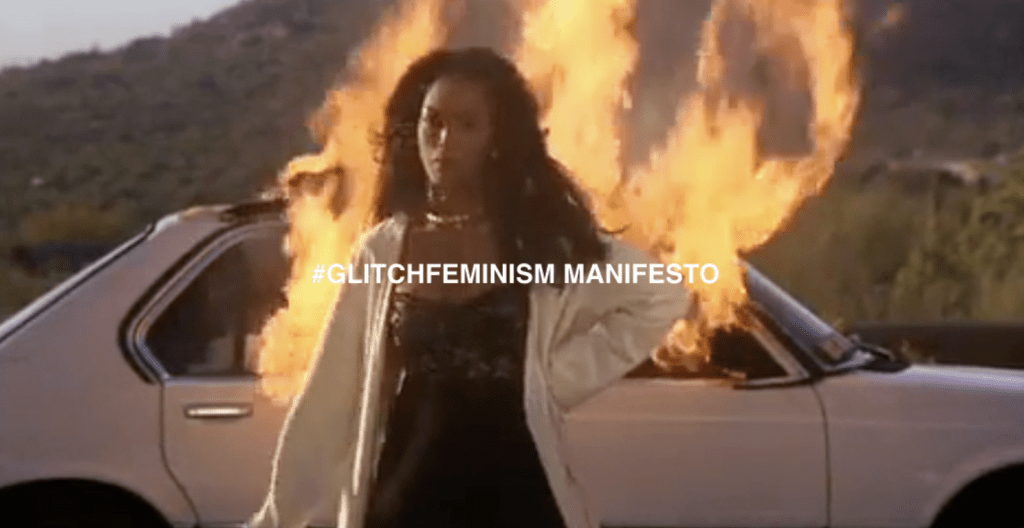
You know we’re in a bubble, right. Someone saw that the book on my lap said “feminism” and asked if I hated myself. Anyway this one’s been on my list since a uni tutor mentioned it to me in passing last year. From what I understood, the basic premise was genuinely exciting; I was thirsty for some writing that tackled how the foundational ideas of cyberfeminism might apply in our new digital landscape—one that’s so violently different to the one that prompted Donna Haraway’s “Cyborg Manifesto” in 1985.
For a few reasons, the actual book sadly fell a little flat, but it doesn’t make Russell’s chosen subject matter any less vital. The channels of creation, control, flow etc. that our current Internet existence has spawned, from the hyper-visible down to the undetectable (and the so-ubiquitous-it’s-just-amniotic-fluid), are the grounds upon which we all have to negotiate identity now cos digital life is real life, the binary has fully melted.
But in how she presented it, it’s hard to say that Russell really brought any cutting attack lines to the conversation. Perhaps it’s cos I’m already largely convinced by the cyberfeminist propositions, but the imprecise call to arms felt a little redundant. Hold the 30-plus-year-old Butler and Haraway texts up to the present day, and most of Russell’s points are already made for you.
Though arguably this is uncharitable because it says “A Manifesto” in bloody gorgeous font on the front. Expecting tight, fleshed-out theory is simply not the brief here. And in general I found it more powerful to read it as such: an emotive text that isn’t here to put to rest your logical questions about how exactly digitalness is such a powerful metaphor + actual tool for exploding gender hegemony.
She’s right. Glitching is about error, refusing to be legible by the machine, fucking the whole thing up. But mateee this kinda radical deconstruction places a duty on the text to do some solid dismantling. Dropping occasional (but admittedly quite vivid and beautiful) attack lines that don’t gel into a powerful enough wrecking ball will, if we seek to live this manifesto, leave the dominant structure a bit uninjured.
For example the twelve sections don’t feel very clear, and the divisions a little arbitrary. Granted, overlapping ideas can be a very strong gluing tactic, but what actually brings that strength is explaining the connections. Also, Russell’s treatment of the current state of the internet feels way too utopian: there’s a couple lines here and there talking about its evils, but it seems she’s let her assessment be overly influenced by personal experience, that is, nostalgia for the sheer liberation permitted by the old forum days. Look at this internet we’re living with now it’s fucked!
One great takeaway though was the artists and creatives she introduced me to—people doing some real politically glitchy work. I’m still eating it up.
I’m writing this like you have all the context already (kinda like the book lol), but I’m taking the artistic decision (huh?) to keep it raw cos I’m lazy. Basically I say you have to become a glitch feminist, but perhaps immerse yourself in the online world of it (that Legacy has greatly contributed to) in case the book leaves you a bit frustrated.
P.S. I have a *beautiful* quote that she used near the beginning:
Do I contradict myself?
Walt Whitman, “Song of Myself” (1892)
Very well then I contradict myself,
(I am large, I contain multitudes.)



 Dani Roade